
The Complete Parking Lot Maintenance Guide for Seattle Business Owners
A straight-talk parking lot maintenance plan for Seattle-area property managers: what to inspect, when to act, and what it costs to get right.
A parking lot is often the first thing customers, tenants, and employees see — and it's also one of the largest maintenance line items a Seattle-area business will face. Get the maintenance plan right and you can stretch a commercial lot's useful life to 25–30 years with predictable, budget-friendly upkeep. Get it wrong, and you'll be doing emergency repairs every winter and facing a full replacement 10 years sooner than you should.
This guide lays out the maintenance plan we recommend for commercial properties across King, Snohomish, Whatcom, and Skagit counties — what to inspect, when to act, and what each intervention actually costs.
Why commercial parking lots are different
Residential driveways and commercial parking lots have a lot in common, but three things make commercial maintenance its own discipline:
- Traffic volume. A busy retail or office lot sees 100x the daily traffic of a driveway. Every passing vehicle concentrates weight on specific spots.
- Liability exposure. Trip-and-fall claims, ADA compliance issues, and vehicle damage from potholes all create legal risk. Maintenance is risk management.
- Scale economics. A 20,000 square-foot lot has 20x the surface area of a driveway, which means small issues at a percentage level become big dollars in absolute terms.
The implication: proactive maintenance pays off dramatically more on commercial properties than residential. The math strongly favors small, regular investments over deferring everything and paying for a full replacement.
The annual maintenance calendar
Here's the rhythm we recommend for a typical Seattle-area commercial lot. Adjust for your traffic, age of pavement, and climate micro-factors (exposed lots, waterfront properties, and hillside locations all have unique needs).
Spring (March–May)
- Walk inspection. Check for winter damage: new cracks, spalling at joints, potholes, failed patches.
- Sweep and clear. Remove winter debris, sand, and salt residue.
- Crack seal. Any crack 1/4 inch or wider should be sealed before the wet season returns.
- Line striping touch-ups. Plan refresh timing based on wear.
Summer (June–August)
- Major repairs. Any asphalt patching, structural work, or full resurfacing is best done in this window.
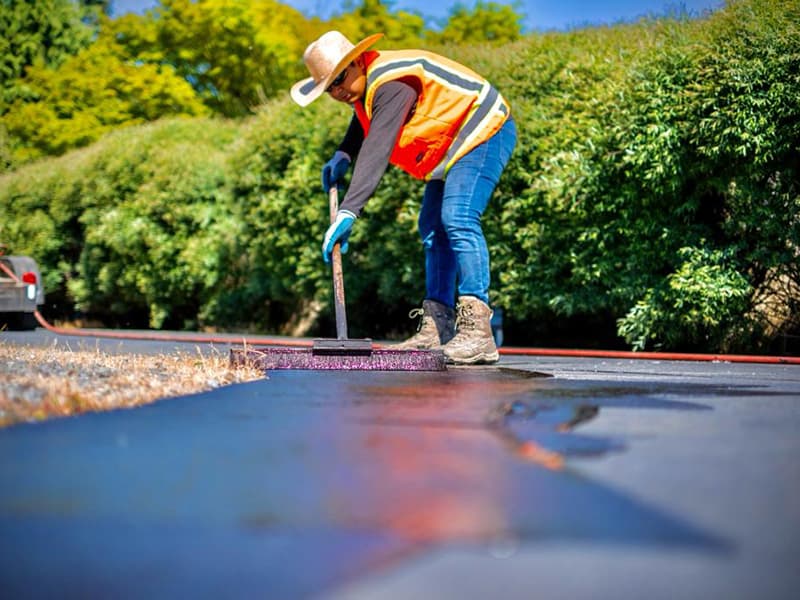
- Sealcoating. Ideal weather. Sealcoat should be applied when pavement is dry, temperatures are above 55°F, and no rain is expected for 48 hours.
- Striping. New layouts, re-striping, or thermoplastic applications all do best in summer.
Fall (September–November)
- Final inspection. Catch anything that needs to be handled before winter.
- Drainage check. Clean catch basins, confirm runoff flows correctly, address any pooling.
- Small crack sealing. Last chance for minor repairs before winter.
Winter (December–February)
- Hold for emergencies. Most structural work waits until spring.
- Address safety issues immediately. Sinkholes, exposed rebar, large potholes can't wait.
- Monitor drainage. Keep catch basins and inlets clear through heavy rain.
The seven-item annual inspection
Every year — ideally in March — walk the lot with a camera and a clipboard. Document the following:
1. Surface condition
Look for:
- Cracking (note width, length, and pattern)
- Alligator cracking (indicates structural failure)
- Raveling (loose aggregate on the surface)
- Potholes
- Depressions that hold water after rain
2. Drainage
Watch the lot after a heavy rain if possible. Look for:
- Standing water anywhere on the surface
- Water flowing toward a building instead of away from it
- Clogged catch basins or grates
- Erosion at drain inlets
3. Striping and markings
Check:
- Parking stall lines (are they still visible?)
- Directional arrows
- ADA accessible stalls and access aisles (required to be in compliance)
- Fire lanes
- Stop bars and pedestrian crossings
4. Signage
Confirm:
- ADA accessible parking signs are present and at correct heights
- Stop signs, directional signs, and reserved parking signs are legible
- Poles and posts are straight and undamaged
5. Curbs and wheel stops
Look for:
- Cracked or broken concrete curbing
- Missing or damaged wheel stops
- Separation between asphalt and adjacent curbing
6. Edges and transitions
Pay special attention to:
- Where asphalt meets concrete (sidewalks, aprons, loading dock areas)
- Edges along landscaping
- Transitions at driveway entrances
7. Lighting and bollards
If applicable:
- Protective bollards at utility connections, building corners, and drive-through areas
- Pavement damage around light pole bases
The five tiers of parking lot maintenance
Every maintenance dollar falls into one of these five tiers. Plan your spending across all of them.
Tier 1: Housekeeping (monthly)
- Sweeping
- Trash pickup
- Clearing drains and catch basins
- Small landscaping edge cleanup
Typical investment: Nominal if done by on-site staff; modest if contracted for a medium-sized lot.
Tier 2: Preventive maintenance (annual)
- Crack sealing
- Small patching
- Inspection reports
- Striping touch-ups
Typical investment: A small fraction of what major repairs cost — the highest-ROI maintenance tier.
Tier 3: Periodic maintenance (every 3–5 years)
- Full lot sealcoating
- Comprehensive re-striping
- Catch basin repairs and adjustments
Typical investment: Meaningful but budgetable — varies significantly with lot size and condition.
Tier 4: Major repair (every 10–15 years)
- Partial resurfacing or overlays
- Full-depth patching of failed sections
- Major crack repair programs
- Curb and sidewalk replacements
Typical investment: A significant capital expense — scope ranges widely based on the extent of damage.
Tier 5: Reconstruction (every 20–30 years)
- Full pavement removal and replacement
- Sub-base reconstruction
- Drainage system overhaul
- Complete striping and signage package
Typical investment: The largest category — typically a major capital project that warrants planning years in advance.
The trap most properties fall into is underspending on Tiers 2 and 3 — which massively accelerates the need for Tier 4 and 5 work. A modest investment in preventive maintenance can delay a full reconstruction by 5–10 years, and the ROI of that deferral is hard to beat with any other property investment.
ADA compliance: the maintenance angle most properties miss
ADA (Americans with Disabilities Act) compliance isn't one-and-done. Over time, striping fades, signs disappear, and access aisles get ambiguous. Commercial properties have ongoing obligations to maintain accessible parking to current standards.
Key items to monitor:
- Number of accessible spaces. The ratio required is tied to total spaces in the lot (1 per 25 up to 100, then different ratios above).
- Van-accessible spaces. At least one of every six accessible spaces must be van-accessible with wider access aisles.
- Signage. Accessible spaces must be marked with signs mounted at the correct height.
- Cross slopes. Accessible spaces and access aisles must have a cross slope of less than 1:48 (about 2%). This can drift out of compliance over time if pavement settles.
- Surface condition. Access routes must be "firm, stable, and slip-resistant."
Non-compliance is a real liability. If your lot is due for re-striping anyway, that's the natural moment to verify everything is still ADA-compliant. Our striping team includes this as part of standard commercial re-striping jobs.
The five mistakes that shorten lot life
1. Waiting for visible damage before acting
The cheapest interventions happen before you can see a problem. Sealcoating, for example, gives you the best ROI when applied to a surface that still looks okay. By the time the surface looks bad, sealcoating no longer solves the problem.
2. Deferring crack sealing
A 1/4 inch crack is a trivial repair. Ignore it for a winter in the Seattle climate and it's a larger one. Ignore it for two winters and it's a patch job that costs many times the original. The math punishes delay exponentially.
3. Using one contractor's scope without a second opinion
For anything over a few thousand dollars, get at least two estimates. A 20–40% price spread is normal, but a 50%+ spread usually means one vendor is cutting corners or overselling. The detailed scope matters more than the bottom line.
4. Rushing winter repairs
Cold patch asphalt, applied in December rain, will not hold. If you have a genuine winter emergency (a hazardous pothole), do a temporary repair and commit to a permanent fix in spring.
5. Ignoring drainage
Every pavement failure we see on commercial properties in the Seattle area has a water component. Clogged drains, wrong slopes, or downspouts discharging onto the lot cause more damage than traffic does. Fix water problems once and the rest of your maintenance plan works.
Building your maintenance budget
For planning purposes, a common rule of thumb is to budget annual parking lot maintenance as a percentage of the lot's replacement value:
- New to 5 years old: 0.5–1% of replacement value per year
- 5–15 years old: 1–2% of replacement value per year
- 15+ years old: 2–4% of replacement value per year, plus a reserve for resurfacing/reconstruction
Budgeting consistently is the goal — spread out year over year rather than absorbed as surprise lumps. Pair this with a capital reserve for the Tier 3, 4, and 5 items. A 3–5 year sealcoat cycle and a 15 year resurface should both be planned years in advance so they don't hit the operating budget as surprises.
A maintenance plan that actually gets followed
The best maintenance plan is the one that gets executed. A few structural suggestions:
- Assign a single responsible owner. Facilities manager, property manager, or owner. One person, not a committee.
- Create a one-page calendar. The monthly/quarterly/annual rhythm on a single sheet. Put it in the facilities binder.
- Contract the professional items with an annual service agreement. Most paving contractors will give you better pricing and scheduling on a multi-year agreement than on one-off calls.
- Photo-document every year. A folder with dated photos of the full lot, taken from the same spots, makes year-over-year change obvious.
- Budget now for the next big job. If your lot is 12 years old, start setting aside money for the 15-year resurface. Don't get surprised.
Ready to plan your parking lot maintenance?
We work with property managers, business owners, HOAs, and facility teams across King, Snohomish, Whatcom, and Skagit counties to keep commercial lots in shape — from routine sealcoating and striping to full resurfacing and reconstruction.
We can provide a condition assessment, a multi-year maintenance plan, or a one-off estimate for a specific job. No pressure, no sales-team theatrics.
Call (206) 751-5657 or request a free estimate. We'll walk your property and give you a written plan you can actually use.
Tags
Keep Reading
Related Articles
 Maintenance
Repair or Replace? A Homeowner's Guide to a Failing Driveway
How to tell if your driveway needs a simple repair, a full overlay, or complete replacement — with honest cost comparisons and red flags.
 Asphalt
How Long Does an Asphalt Driveway Last in Seattle's Climate?
A properly installed asphalt driveway in Seattle lasts 20–30 years. Here's what affects that number, what shortens it, and how to get decades more.
 Sealcoating
Is Sealcoating Worth It? What 5 Years Without It Really Costs
Sealcoating is the single highest-ROI maintenance a Seattle driveway can get. Here's what skipping it actually costs — and what it's worth.
Ready to Start Your Paving Project?
Put our expertise to work for you. Get a free, no-obligation estimate from Seattle's premier paving company.