
Is Sealcoating Worth It? What 5 Years Without It Really Costs
Sealcoating is the single highest-ROI maintenance a Seattle driveway can get. Here's what skipping it actually costs — and what it's worth.
Short answer: yes, sealcoating is worth it for almost every asphalt driveway in the Seattle area. The longer answer is about the math — a modest investment every 3–4 years can delay a full driveway replacement by a full decade. That's the kind of return almost no other home-maintenance spend offers.
This post walks through exactly what sealcoating does, what 5 years of neglect actually looks like in the Pacific Northwest, when it's worth skipping, and how to get it done right.
What sealcoating actually is
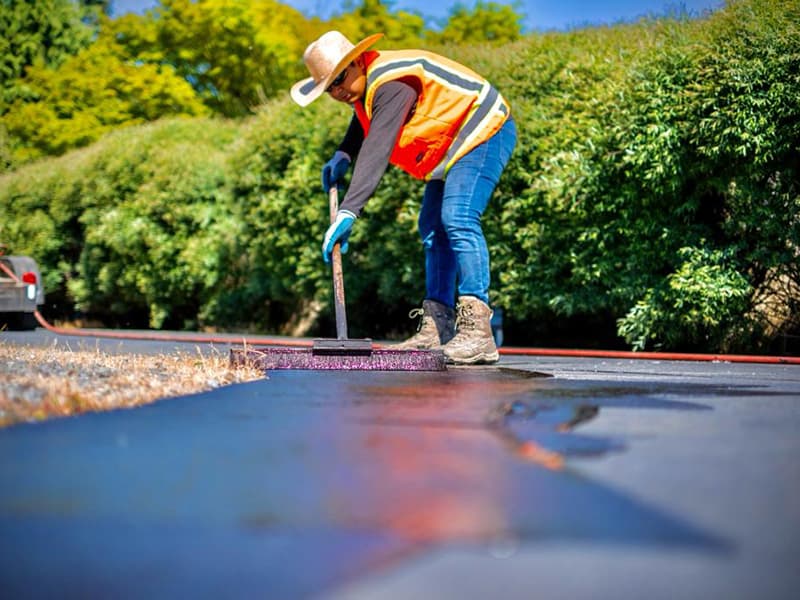
Sealcoat is a thin, protective emulsion — usually asphalt-based or coal-tar-based — applied over an existing asphalt surface. It does four specific jobs:
- Fills surface porosity. New asphalt is microscopically porous. Water and oils work their way in through those pores. Sealcoat plugs them.
- Blocks UV rays. Sunlight breaks down the asphalt binder that holds the surface together. Sealcoat absorbs UV before it reaches the binder.
- Resists chemicals. Gasoline, motor oil, and deicing salts all accelerate asphalt breakdown. A sealed surface sheds them.
- Restores appearance. A fresh sealcoat turns a faded gray driveway back to deep black, sharp-edged and uniform.
The key thing to understand: sealcoat is not a structural layer. It doesn't make a driveway thicker or fix underlying damage. It protects what's already there from wearing out faster than it needs to.
What 5 years of skipped sealcoating costs
To show the real cost of neglect, let's walk through what happens to an unsealed Seattle driveway over five years. This is the typical trajectory we see on Puget Sound-area properties that haven't been maintained.
Year 1: Surface oxidation begins
UV exposure starts breaking down the top layer of asphalt binder. The surface shifts from jet black to dark gray. You probably don't notice much visually — but chemistry is already working against you.
Year 2: Porosity increases
The surface is now measurably more porous than when it was installed. Rainwater, which used to bead off, starts soaking in. In winter, that trapped moisture freezes and expands, creating microscopic fractures in the asphalt matrix.
Year 3: First visible cracking
Hairline cracks appear, usually starting at the edges and in high-stress areas near the garage or driveway entrance. These are small enough that most homeowners ignore them. They shouldn't — this is the cheapest moment to act.
Year 4: Water infiltration reaches the sub-base
Cracks that were hairline are now 1/8 to 1/4 inch wide. Winter rains flow directly through them into the sub-base beneath. With each freeze-thaw cycle in Seattle's climate, the sub-base shifts slightly. Once this starts, the damage accelerates.
Year 5: Structural damage is visible
You now have "alligator cracking" in spots — a network of interlinked cracks that form roughly rectangular shapes. You may have a soft spot or two where the sub-base has failed. Small potholes are forming. The driveway that had 25 years of potential life left has lost maybe 10 of them.
The cost of sealcoating a driveway over 5 years is a small fraction of what repairing the damage from skipped sealcoating typically costs in crack repair and patching — plus you lose years of driveway life in the process.
The real ROI math
Here's how the 20-year picture typically breaks down for a residential driveway in the Seattle area (King, Snohomish, or neighboring counties):
| Scenario | Relative 20-Year Spend |
|---|---|
| New asphalt driveway install | Big upfront, zero if you're not replacing |
| Sealcoating on schedule | Small, recurring |
| Crack filling as needed | Small, reactive |
| Total with maintenance | Lower overall |
| Skip maintenance + replace early | Significantly higher |
Maintenance isn't free, but it's genuinely cheaper than the alternative — and it delays the next big spend by 5–10 years. Exact numbers depend on driveway size, site conditions, and local pricing; request a free estimate for figures specific to your property.
When to sealcoat (and when not to)
The right timing
- First sealcoat: 2–3 years after initial installation. New asphalt needs time to cure so trapped oils can fully evaporate.
- Recurring sealcoats: Every 3–4 years in Seattle. Drier climates can stretch to 5, but our wet winters accelerate wear.
- Best season to apply: May through September. Dry weather for at least 48 hours, temperatures above 55°F.
When sealcoating isn't the answer
Sealcoating is a protective measure, not a fix. Don't spend money on a sealcoat if:
- Large cracks already exist (wider than 1/4 inch) — these need crack sealing first
- Sub-base failure is visible — soft spots, depressions, or potholes need structural repair, not surface treatment
- The driveway is past 20 years old and showing widespread cracking — at that point, an overlay or replacement makes more sense
- You're planning to resurface within a year anyway
A good contractor will tell you if sealcoating doesn't make sense. If someone is pushing sealcoat onto a driveway that clearly needs structural work, get a second opinion.
Types of sealcoat: what's actually being applied
Not all sealcoat products are the same, and the marketing can be misleading. Here's what you're actually getting:
Asphalt-based emulsions
The most common professional product. Water-based with suspended asphalt particles. Applied cold, cures as water evaporates. Environmentally friendlier than coal-tar, meets most regional regulations, and performs very well in the Pacific Northwest.
Coal-tar emulsions
Petroleum byproduct. Historically very durable and chemical-resistant, but phased out in many areas due to environmental and health concerns. Many Pacific Northwest jurisdictions restrict its use.
Acrylic / polymer-modified
Higher-end products that add acrylic polymers for improved flexibility and adhesion. Costs more, lasts slightly longer. Makes sense for commercial applications or driveways that see unusual wear.
DIY sealers
The gallon jugs at hardware stores. They'll coat your driveway and look fine at first, but they're typically 30–50% solids (vs. 50–60% for commercial-grade) and lay down thinner. Expect roughly half the lifespan of a professional application.
For most homeowners, the math favors hiring a professional every 3–4 years over DIY annually. You spend less time, get better results, and the total lifespan is longer.
What a professional sealcoating job should include
When you hire out sealcoating, the job should be more than "spray and leave." A quality sealcoat service in the Seattle area includes:
- Surface cleaning. Power-blowing or sweeping the entire driveway. Pressure washing if there are oil stains or heavy moss.
- Oil spot treatment. Primer applied to oil-saturated spots so the sealcoat bonds properly.
- Crack filling. Small cracks (under 1/4 inch) filled as part of the prep. Larger cracks may need a separate crack seal service.
- Edge and detail work. Careful hand-cutting along garages, curbs, and landscaping.
- Two-coat application. One coat is spreading; two coats is sealing. High-quality work uses two coats on main surfaces.
- Clear cure time. The driveway should be blocked off for 24–48 hours depending on product and weather.
If you're getting estimates and one contractor's price is significantly lower, ask what's included. The difference is almost always in the prep work and the number of coats.
Myths worth dispelling
"Sealcoating fixes cracks." It doesn't. Sealcoat is roughly 1/16 of an inch thick — it flows into cracks and right back out. Cracks need a dedicated filler. Sealcoat comes after.
"New driveways should be sealed right away." No. Fresh asphalt needs to cure. Seal too soon and you trap volatile oils that need to escape. Wait 12–24 months minimum.
"Once is enough." Sealcoat is sacrificial — it wears away over time so the asphalt underneath doesn't have to. Expect to reseal every 3–4 years for the life of the driveway.
"Sealed driveways don't crack." They do. Less, and more slowly, but cracking is a natural part of asphalt aging. The goal is to slow it down and keep existing cracks small.
"I can DIY this." You can. It'll look decent for a year. But the commercial-grade product and professional equipment a paving contractor uses deliver 2–3x the lifespan per dollar spent, and there's no learning curve.
The real bottom line
For a typical Seattle homeowner with an asphalt driveway, sealcoating is one of the highest-return maintenance investments available. A few hundred dollars every few years reliably buys you another decade of driveway life — and keeps the surface looking the way it did when it was new.
The only driveways that shouldn't be sealcoated are ones that need bigger work first. If yours is in that camp, we'll tell you.
Ready to protect your driveway?
We sealcoat driveways, parking lots, and private roads across King, Snohomish, Whatcom, and Skagit counties. Every job includes proper prep, crack filling for small cracks, and two-coat application with commercial-grade product.
Call (206) 751-5657 or request a free estimate. We'll walk the property, tell you honestly what it needs, and give you a written quote with no pressure.
Tags
Keep Reading
Related Articles
 Asphalt
How Long Does an Asphalt Driveway Last in Seattle's Climate?
A properly installed asphalt driveway in Seattle lasts 20–30 years. Here's what affects that number, what shortens it, and how to get decades more.
 Maintenance
Repair or Replace? A Homeowner's Guide to a Failing Driveway
How to tell if your driveway needs a simple repair, a full overlay, or complete replacement — with honest cost comparisons and red flags.
 Maintenance
The Complete Parking Lot Maintenance Guide for Seattle Business Owners
A straight-talk parking lot maintenance plan for Seattle-area property managers: what to inspect, when to act, and what it costs to get right.
Ready to Start Your Paving Project?
Put our expertise to work for you. Get a free, no-obligation estimate from Seattle's premier paving company.